-
Head
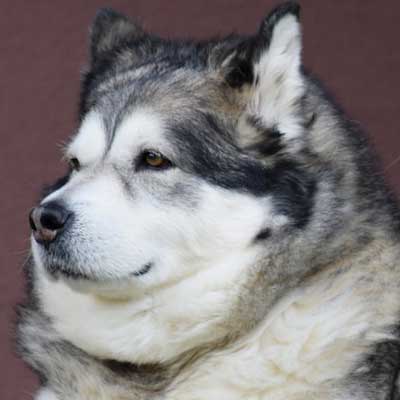
The head is broad and deep, not coarse or clumsy, but in
proportion to the size of the dog.
The expression is soft and indicates an affectionate disposition.
-
Head - cranial region
Skull: Broad and moderately rounded between the ears, gradually
narrowing and flattening on top as it approaches the eyes, rounding off to cheeks. There is a slight furrow between the eyes. The topline of the skull and the topline of the muzzle show a slight break downward from a straight line as they join.
Stop: Shallow.
-
Head - facial region
Nose: In all coat colors, except reds, the nose, lips, and eye rim
pigmentation is black. Brown is permitted in red dogs. The lighter
streaked « snow nose » is acceptable.
Muzzle: Large and bulky in proportion to the size of the skull,
diminishing slightly in width and depth from junction with the skull
to the nose.
Lips: Close fitting.
Jaws/Teeth: Broad with large teeth. The incisors meet with a scissor bite. Overshot or undershot is a fault.
Cheeks: Moderately flat.
Eyes: Obliquely placed in the skull. Eyes are brown, almond
shaped and of medium size. Blue eyes are a disqualifying fault.
Ears: Of medium size, but small in proportion to the head.
The ears are triangular in shape and slightly rounded at tips. They are set wide apart on the outside back edges of the skull on line with the upper corner of the eye, giving ears the appearance, when erect, of standing off from the skull. Erect ears point slightly forward, but when the dog is at work, the ears are sometimes folded against the skull. High set ears are a fault.
-
Neck
Strong and moderately arched.
-
Body
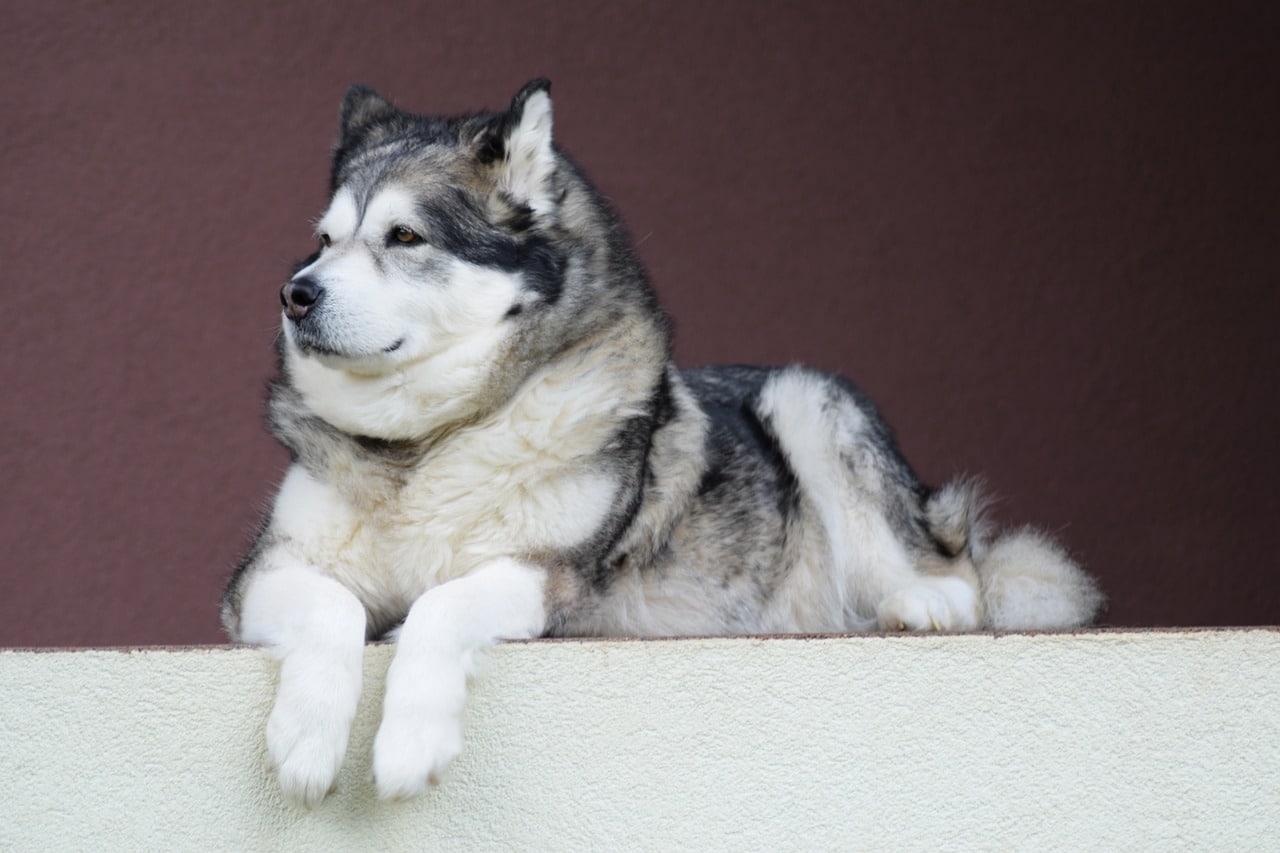
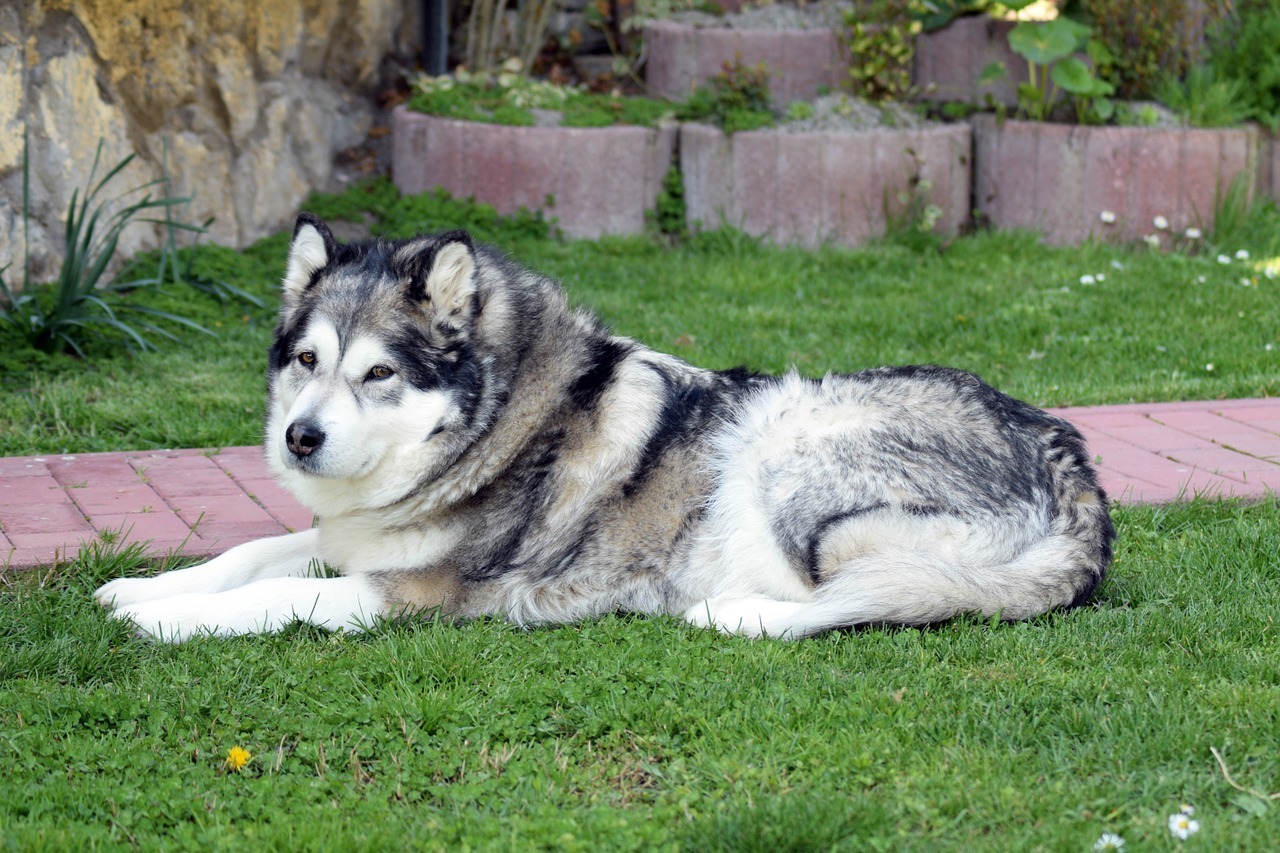
Compactly built but not short coupled. The body carries no
excess weight, and bone is in proportion to size.
Back: Straight and gently sloping to the hips.
Loins: Hard and well muscled. A long loin that may weaken the
back is a fault.
Chest: Well developed.
-
Tail
Moderately set; follows the line of the spine at the base.
Carried over the back when not working.
It is not a snap tail or curled tight against the back, nor is it short furred like a fox brush.
The Malamute tail is well furred and has the appearance of a waving plume.
-
Forequarters
General appearance: Forelegs heavily boned and muscled, straight to the pasterns when viewed from the front.
Shoulder: Moderately sloping.
Pasterns: Short and strong and slightly sloping when viewed from the side.
-
Hindquarters
General appearance: The rear legs are broad. When viewed from the rear, the legs stand and move true in line with the movement of the front legs, not too close or too wide.
Thighs: Heavily muscled.
Stifles: Moderately bent.
Hock joints: Moderately bent and well let down.
-
Feet
Forefeet: Of the « snowshoe » type, tight and deep, with wellcushioned pads, giving a firm, compact appearance. The feet are large, toes tight fitting and well arched. There is a protective growth of hair between the toes. The pads are thick and tough; toenails short and strong.
Hind feet: Of the « snowshoe » type, tight and deep, with wellcushioned pads, giving a firm, compact appearance. The feet are large, toes tight fitting and well arched. There is a protective growth of hair between the toes.
The pads are thick and tough; toenails short and strong.
Dewclaws on the rear legs are undesirable and should be removed
shortly after puppies are whelped.
-
Gait / Movement
The gait of the Malamute is steady, balanced and powerful. He is agile for his size and build. When viewed from the side, the hindquarters exhibit strong rear drive that is transmitted
through a well-muscled loin to forequarters. The forequarters
receive the drive from the rear with a smooth reaching stride.
When viewed from the front or from the rear, the legs move true in line, not too close or too wide. At a fast trot, the feet will converge toward the centerline of the body. A stilted gait, or any gait that is not completely efficient and tireless is to be penalized.
-
Coat - hair
The Malamute has a thick, coarse guard coat, never long and
soft.
The undercoat is dense, from one to two inches in depth, oily
and woolly. The coarse guard coat varies in length as does the
undercoat. The coat is relatively short to medium along the sides of the body, with the length of the coat increasing around the shoulders and neck, down the back, over the croup and in the breeching and plume.
Malamutes usually have a shorter and less dense coat during the summer months.
The Malamute is shown naturally.
Trimming is not acceptable except to provide a clean-cut appearance of feet.
-
Coat - colour
The usual colours range from light grey through intermediate
shadings to black, sable, and shading of sable to red.
Colour combinations are acceptable in undercoats, points and
trimmings. The only solid colour allowable is all-white.
White is always the predominant colour on underbody, parts of legs, feet, and part of face markings. A white blaze on the forehead and/or collar or a spot on the nape is attractive and acceptable.
The Malamute is mantled, and broken colours extending over the body or uneven splashing are undesirable.
-
Size
There is a natural range in size in the breed. The
desirable freighting sizes are:
Males: 25 inches at the shoulders - 85 pounds (63,5 cm - 38 kg).
Females: 23 inches at the shoulders - 75 pounds (58,5 cm - 34 kg).
However, size consideration should not outweigh that of type,
proportion, movement and other functional attributes. When dogs
are judged equal in type, proportion, movement, the dog nearest the desirable freighting size is to be preferred.
-
Important summary
In judging Alaskan Malamutes their function as a sledge dog for heavy freighting in the Arctic must be given consideration above all else.
The degree to which a dog is penalized should depend upon the extent to which the dog deviates from the description of the ideal Malamute and upon the extent to which the particular fault would actually affect the working ability of the dog.
The legs of the Malamute must indicate unusual strength and tremendous propelling power. Any indication of unsoundness in legs and feet, front or rear, standing or moving, is to be considered a serious fault.
Faults under this provision would be splay-footedness, cowhocks, bad pasterns, straight shoulders, lack of angulation, stilted gait (or any gait that isn’t balanced, strong and steady), ranginess, shallowness, ponderousness, lightness of bone and poor overall proportion.
-
Faults
Any departure from the foregoing points should be
considered a fault and the seriousness with which the fault should be regarded should be in exact proportion to its degree and its effect upon the health and welfare of the dog.
-
Disqualifying faults
• Aggressive or overly shy dogs.
• Any dog clearly showing physical or behavioural abnormalities.
• Blue eyes.
N.B.:
• Male animals should have two apparently normal testicles fully descended into the scrotum.
• Only functionally and clinically healthy dogs, with breed
typical conformation should be used for breeding.