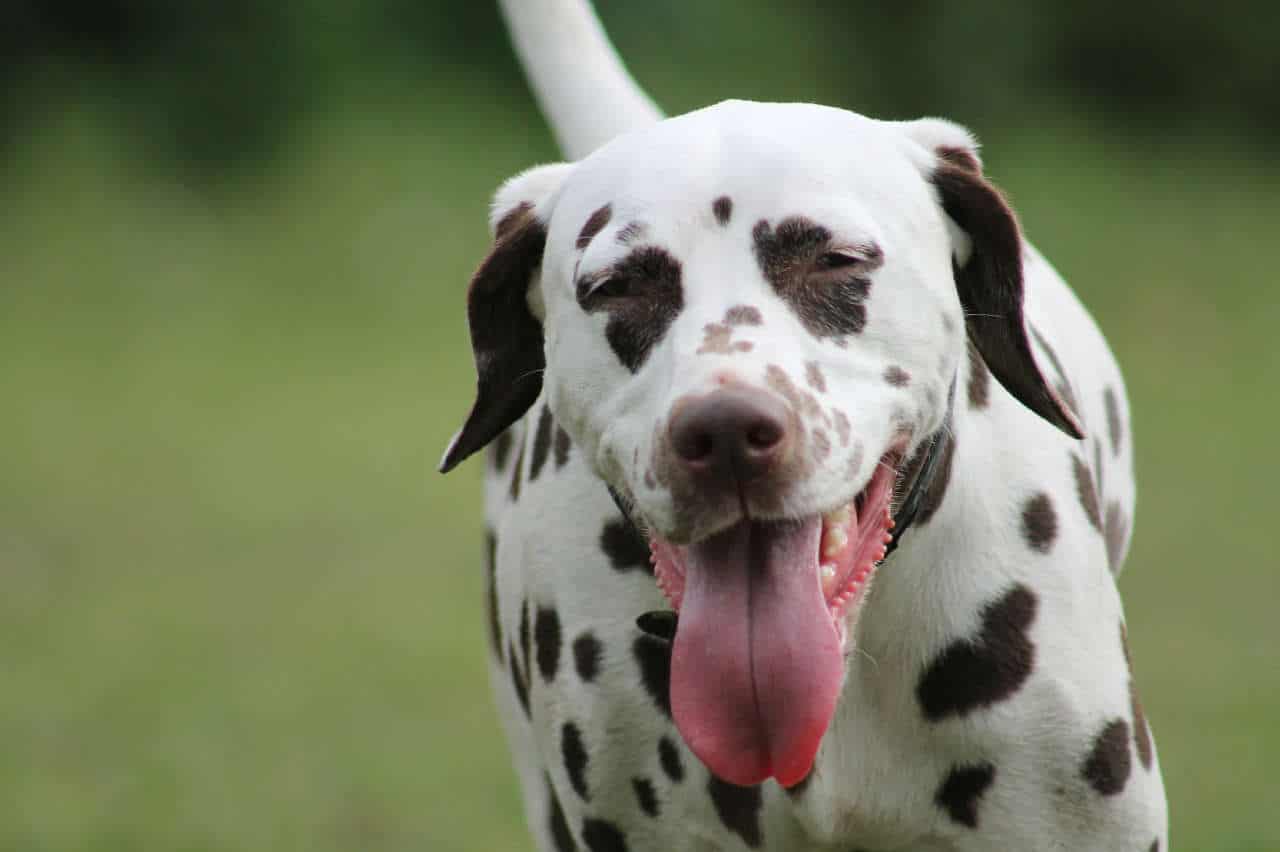
-
Head
The head must be in proportion and harmony with the rest
of the body and not too wide in the skull area. The length from the occipital protuberance to the stop and from the stop to the tip of the nose equals 1:1, or the muzzle is slightly shorter.
The upper line of the skull and the upper line of the muzzle are slightly divergent. The masseter muscle and the cheek bone must not be too developed. The head must be entirely free from wrinkle.
-
Head - skull region
Skull: Flat, with a slight lateral rounding. Broadest between the ears and well defined temples. Slight frontal furrow.
Stop: Moderately defined.
-
Head - facial region
Nose: Large with wide open nostrils, it must be completely
pigmented. The colour must be in accordance to the colour of the spotting.
Muzzle: Well developed & strong jawbone, nasal bridge straight.
Lips: Strong, must fit the jaw rather closely and not be pendulous, or too thick; without the corner of the mouth too defined. A complete pigmentation is desired.
Jaws / Teeth: Scissor bite, i.e. the upper 6 incisors closely
overlapping the lower teeth, with all teeth set square to the jaw. A complete set of teeth (42 teeth) is desired (in accordance with the teeth formula). The teeth are evenly formed and white. A pincer bite is tolerated in older dogs.
Eyes: Oval, in a sub-frontal position placed at an angle of 10-15˚.
The eye colour is in accordance with the spotting. Eyelids are close to the eyeball and not loose. Eye rims are completely pigmented in accordance with the coat colour.
Ears: Set on rather high, carried close to the lateral part of the head. The length reaches to the inner corner of the eye or to the stop.
The tip is slightly rounded. The ears have the shape of an isosceles triangle. They are fine in texture and soft to the touch. It is very important that the ears are spotted, i.e. the ears must not be completely black or brown but black or brown spotted etc. with the spotting in accordance with the colour variety on the white base.
-
Neck
The neck should be strong and fairly long, tapering towards
the head and free from throatiness.
-
Body
Rectangular, proportions of length of body to the height at
the withers is 10: 9.
Withers: Well defined.
Back: Powerful, level.
Loin: Short and muscular.
Croup: Muscular, inclined less than 30°.
Chest: Deep and capacious, not too broad or barrel-shaped. The depth of the chest should be 45-50% of the height to the withers. The height of the elbow is 50% of the height to the withers. The ribs are well sprung.
Underline and belly: The belly is moderately tucked up but not drawn in.
-
Tail
Set on at the extension of the croup. Reaching approximately to the hock or slightly longer. Strong at the base evenly tapering towards the tip, not too thick but in proportion to the body.
Carried sabre-shaped. Preferably spotted.
-
Forequarters
General appearance: The forelegs must be in proportion to the rectangular body.
Shoulder: The shoulder angle is around 115-120˚
Elbow: Close to the body.
Forearm: The bones are developed in proportion to the body and strong (round), forequarters placed straight and legs standing vertical.
Metacarpus (Pastern): Strong, slightly sloping with a spring.
Forefeet: The toes are compact, so called cat feet are typical. Pads are tough and elastic. The nails should preferably be pigmented.
-
Hindquarters
General appearance: In proportion to the body. With strong well developed muscles. Hindlegs are parallel.
Thigh: Muscular and strong.
Stifle (Knee): Strong and well developed. The stifle has an angle of 40 degree to the horizontal line.
Hock joint: Strong.
Metatarsus (Rear pasterns): The length of the hocks is around 20-25% of the height to the withers. The angle of the hock is around 130˚.
Hind feet: The toes are compact, so called cat feet are typical. Pads are tough and elastic. The nails should preferably be pigmented.
-
Gait / Movement
Rhythmic action, elegant and smooth movement. Stride and trot long with good reach and strong drive.
Viewed from the front the legs are parallel.
-
Coat / Hair
Hair: Short, shiny, hard and dense all over the body.
Colour: The ground colour is pure white. Black spotted variety with black spots, liver spotted variety with brown spots. The spots should be symmetrically placed all over the body, clearly defined and without intermingling into the white ground colour.
The size of the spots should preferably be even, with a size of 2 – 3 cm in diameter.
In the brown variety the spots are a little smaller, around 2 cm. The spots on the head and on the legs should be proportional smaller than on the rest of the body. It is desirable the tail is spotted too, with spots also proportional smaller that those on the body.
Splashes on the body are not desirable and should be penalised. The spots must not intermingle, i.e. forming large patches. Patches and coloured areas are not desirable. The spots on the ears should be especially noted.
-
Size and weight
Height at the withers: Males 56 – 62 cms. Females 54 – 60 cms.
Dogs with excellent type and balance should not be penalised if above the upper limit.
-
Faults
Any departure from the foregoing points should be considered a fault and the seriousness with which fault should be regarded should be in exact proportion to its degree and its effect upon the health and welfare of the dog and on its ability to perform its traditional work.
-
Disqualifying faults
• Aggressive or overly shy.
• Any dog clearly showing physical or behavioural abnormalities.
• Converging head line.
• The lack of more than 6 premolars, the lack of M3 is not noted and will not be considered as a fault.
• Entropion, ectropion, wall eye, eyes of different colours
(heterochromia), blue eyes, partially blue coloured iris.
• Lack of nose pigment.
• Curled tail.
• Monocle (patching around one or both eyes) or patching
elsewhere.
• Tricolour (black and brown spots on the same dog), brindle coloured spots, lemon coloured spots, orange coloured spots, blue spots and pure white colour without spots.
• Wirehaired or longhaired
• Deafness
N.B.:
• Male animals should have two apparently normal testicles fully descended into the scrotum.
• Only functionally and clinically healthy dogs, with breed typical conformation should be used for breeding.