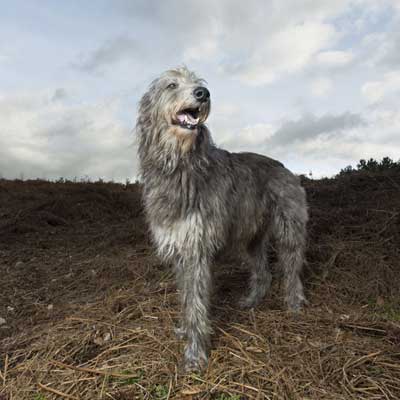
Irish Wolfhound

Huge all around: for his character, for the size, for the courage

  • Carattere
    75%
  • Energie a disposizione
    70%
  • Cura del pelo
    45%
  • Rapporto con i bambini
    50%
  • Problemi con altri animali
    20%

GRUPPO ENCI

Group 10

TAGLIA

Large

ASPETTATIVA DI VITA

10-12 years

We know the continental Celts kept a greyhound probably descended from the greyhound first depicted in Egyptian paintings.Like their continental cousins, the Irish Celts were interested in breeding large hounds. These large Irish hounds could have had smooth or rough coats, but in later times, the rough coat predominated possibly because of the Irish climate.The first written account of these dogs was by a Roman Consul 391 A.D. but they were already established in Ireland in the first century A.D. when Setanta changed his name to Cu-Chulainn (the hound of Culann). Mention is made of the Uisneach (1st century) taking 150 hounds with them in their flight to Scotland.Irish hounds undoubtedly formed the basis of the Scottish Deerhound. Pairs of Irish hounds were prized as gifts by the Royal houses of Europe, Scandinavia and elsewhere from the Middle ages to the 17th century. They were sent to England, Spain, France, Sweden, Denmark, Persia, India and Poland.In the15th century each county in Ireland was required to keep 24 wolfdogs to protect farmers' flocks from the ravages of wolves. The Cromwellian prohibition (1652) on the export of Wolfhounds helped preserve their number for a time but the gradual disappearance of the wolf and continued demand abroad reduced their numbers almost to the point of extinction by the end of the 17th century.The revival of interest in the breed accompanied the growth of Irish nationalism in the late 19th century. The Irish Wolfhound became a living symbol of Irish culture and of the Celtic past. At this time, one determined enthusiast, Capt. G A Graham, set about obtaining some of the few remaining hounds of the Wolfhound type that could still be found in Ireland, and with the use of Deerhound blood and the occasional outcross of Borzoi and Great Dane, he eventually achieved a type of dog that bred true in every generation.The results were ultimately accepted as a legitimate revival of the breed. The Irish Kennel Club scheduled a class for Irish Wolfhounds at their show in April 1879, and a club was formed in 1885.The Irish Wolfhound now enjoys once again something of the reputation that it had in the Middle Ages. Wolfhounds are now owned and bred in fairly large numbers outside of Ireland.
He is a gentle and easy to train dog.He prefers wide open spaces, although he easily adapts to domestic life as long as he is kept fit.He tends to choose one member of the family, although he is always lovely with all. Absolutely reliable with kids, though his size should be kept into consideration to avoid possible issues.
GENERAL APPEARANCEThe Irish Wolfhound should not be quite so heavy or massive as the Great Dane, but more so than the Deerhound, which in general type he should otherwise resemble.Of great size and commanding appearance, very muscular, strongly though gracefully built, movements easy and active; head and neck carried high; the tail carried with an upward sweep with a slight curve towards the extremity.Great size, including height at shoulder and proportionate length of body, is the desideratum to be aimed at, and it is desired to firmly establish a race that shall average 32 inches (81cm) to 34 inches (86cm) in dogs, showing the requisite power, activity, courage and symmetry.BEHAVIOUR - TEMPERAMENT"Lambs at home, lions in the chase".
  • Head

  • Head - skull region

  • Head - facial region

  • Neck

  • Body

  • Tail

  • Forequarters

  • Hindquarters

  • Feet

  • Gait / Movement

  • Coat - hair

  • Coat - colour

  • Size and weight

  • Faults

  • Disqualifying faults

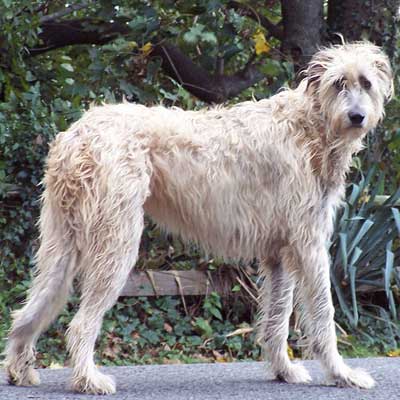
Irish Wolfhound

Grande in tutto: nel carattere, nella stazza, nel coraggio
  • Carattere
    75%
  • Energie a disposizione
    70%
  • Cura del pelo
    45%
  • Rapporto con i bambini
    50%
  • Problemi con altri animali
    20%

GRUPPO ENCI

Gruppo 10

TAGLIA

Grande

ASPETTATIVA DI VITA

10-12 anni

Questa razza ha origini recenti ma è una sorta di recupero, di razza “ricostruita” per assomigliare al mitico “Irish Hound”, estinto, risalente forse al primo secolo A.C. o anteriore.Originariamente era allevato come cane da guerra dagli antichi Celti che poi passò nelle mani degli abitanti delle terre di Irlanda continuando ad essere sia da guerra ma imparando anche a fare il cane da guardia, per proteggere la casa e gli allevamenti.Verso la fine del XIX secolo grazie al capitano scozzese George Augustus Graham, che incrociò esemplari di Deerhound con esemplari di Alano Tedesco e di Borzoi Russo, venne finalmente riconosciuto come una legittima rinascita della razza.
È un cane gentile, tranquillo, intelligente e facile da addestrare.Ha la tendenza ad affezionarsi ad una persona sola anche se è molto dolce, amorevole con tutti i membri della propria famiglia; ama giocare con i bimbi e prendersi cura di loro anche se bisogna fare attenzione per la grande mole dell'esemplare. È impavido e grande abbaiatore.Si adatta alla vita domestica anche se preferisce ampi spazi aperti dove poter fare tanto movimento e tenersi sempre in forma.
ASPETTO GENERALEL’Irish Wolfhound non dovrebbe essere pesante o massiccio come l’Alano, ma deve esserlo più del Deerhound, al quale d’altra parte assomiglia in generale.Di grande taglia e aspetto imponente, molto muscoloso, di costruzione forte ma aggraziata, movimento sciolto e attivo; testa e collo portati alti; la coda portata con una spazzola verso l’alto, con una leggera curva verso l’estremità.La grossa taglia, includendo l’altezza al garrese e la proporzionale lunghezza del corpo, è lo scopo da raggiungere e si desidera fermamente di mantenere una razza che stabilisce una media di 81 cm fino a 86 cm nei maschi, mostrando la potenza richiesta, attività, coraggio e simmetria. COMPORTAMENTO - CARATTERE"agnello in casa, leone a caccia"
  • Testa

  • Testa - regione del cranio

  • Testa - regione del muso

  • Collo

  • Corpo

  • Coda

  • Arti anteriori

  • Arti posteriori

  • Piedi

  • Andatura

  • Mantello - pelo

  • Mantello - colore

  • Taglia e peso

  • Difetti

Leave a reply

Your email address will not be published. Required fields are marked *

L'INTERVISTA

Nessuna intervista trovata

I SERVIZI

Nessun servizio trovato

CANI DELLO STESSO GRUPPO

  • Irish Wolfhound
  • Afghan Hound
  • Deerhound

Utenti che hanno questa razza

Nessun utente trovato