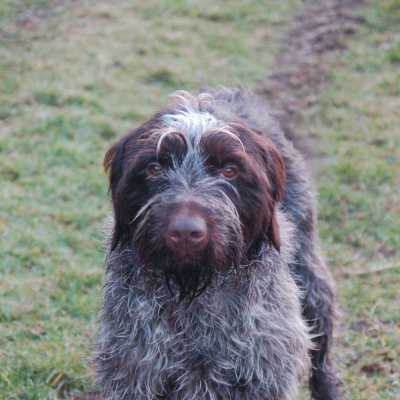
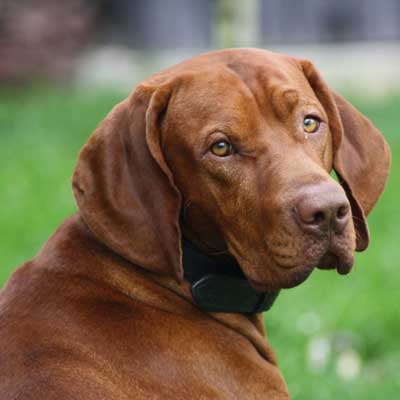
-
Head
Big and long, with harsh hair, thick but not too long;
moustache, beard and eyebrows well developed.
-
Head - skull region
Skull: Not too broad. The upper lines of the skull and the muzzle are
parallel.
Stop: Not too pronounced.
-
Head - facial region
Nose: Always brown.
Muzzle: Long and square, of the same length as the skull, bridge of the nose slightly convex.
Eyes: Dark yellow or brown, large, rounded surmounted but not
covered by the eyebrows, very intelligent expression.
Ears: Of medium size, not curled inwards, flat, set on level line
with the eyes, the short hair which covers them is more or less mixed with longer hairs.
-
Neck
Moderately long, without dewlap.
-
Body
Its length is markedly greater than the height at the withers
(from 1/20th to 1/10th).
Back: Strong.
Loin: Well developed.
Chest: Deep, not too wide, ribs slightly sprung.
-
Tail
Carried horizontally or with the tip slightly raised, covered with thick hair but without fringing, generally should be docked by a third or a quarter.
If it were not shortened, it would be carried horizontally with its tip slightly raised.
-
Forequarters
General appearance: Straight, vigorous, with thick hair. In action,
the forelegs are perfectly parallel.
Shoulder: Well set on, rather long, very oblique.
Forefeet: Round, strong, toes tight and arched.
-
Hindquarters
General appearance: Covered with thick hair.
Thighs: Long and well muscled.
Hocks : Well angulated.
Hind feet: Round, strong, toes tight and arched.
-
Gait / Movement
The hunting gait is the gallop, punctuated by periods of trot. The trot is extended. Catlike movement when walking up game.
-
Coat - hair
Harsh and coarse, reminding of the touch of a wild boar’s bristles. Never curly or woolly.
Under the harsh top coat is a fine dense undercoat.
-
Coat - colour
Preferably steel grey shade with brown (liver) patches or
self-coloured brown (liver) coat.
Frequently liver-roan or a close mixture of brown (liver) and white hairs. Equally permissible white and brown and white and orange coats.
-
Size and weight
About 55 to 60 cm for males and 50 to 55 cm for females.
-
Faults
Any departure from the foregoing points should be considered a fault and the seriousness with which the fault should be regarded should be in exact proportion to its degree and its effect upon the health and welfare of the dog
-
Disqualifying faults
• Aggressive or overly shy dogs.
• Any dog clearly showing physical of behavioural abnormalities.
N.B.:
• Male animals should have two apparently normal testicles fully
descended into the scrotum.
• Only functionally and clinically healthy dogs, with breed
typical conformation should be used for breeding.